


Digital Detox Benefits – We live in an era where screens are unavoidable. They keep us connected, informed and entertained — but they also fragment our attention, make sleep worse, and correlate with rising rates of anxiety and low mood in some groups. That’s where the digital detox comes in: a deliberate, structured reduction in screen use so you can restore focus, sleep deeper, and reclaim time for real-world relationships and projects.
This long, practical guide explains what a digital detox is, what the research shows, the main benefits (mental health, sleep, productivity), and exactly how to run a detox that actually sticks.
Table of Contents
What “digital detox” really means
A digital detox is a purposeful reduction or temporary pause in using digital devices (phones, tablets, social apps, streaming services, sometimes TV) to lower distraction and give your brain recovery time. Detoxes range from single-day “phone fasts” to multi-week re-designs of how you use technology. Importantly, a detox is not about “going Luddite” — it’s about creating healthier boundaries so technology serves you rather than the other way around.
The evidence: why experts take screen time seriously
Two big patterns in recent research matter for anyone considering a detox:
- High screen time is common and linked to poorer sleep and mental-health indicators among teens and young adults. National surveys show that roughly half of teenagers report 4+ hours of daily non-school screen time, and those with higher screen use report greater rates of anxiety and depressive symptoms. That correlation doesn’t prove cause in every case, but the public-health signal is strong enough to treat high evening screen use as a modifiable risk factor for sleep and mood problems.
- Evening screen exposure (light + late stimulation) disrupts sleep biology. The blue-rich light from phones/tablets suppresses melatonin and shifts circadian timing, delaying sleep onset and fragmenting sleep architecture. Put simply: scrolling late makes you fall asleep later, sleep lighter, and feel worse the next day. Reducing screen use before bed reduces melatonin suppression and helps reset sleep timing.
Those two facts — behavioral association and a plausible physiological pathway (light + arousal) — are the backbone of why digital detoxes improve sleep and mood for many people.
Public-health research such as the U.S. CDC analysis of youth screen use notes that higher screen exposure is associated with poorer sleep habits and increased reports of anxiety and depressive symptoms among adolescents. CDC report on screen time and youth health
Key benefits of a digital detox
Below are the most commonly observed and researched benefits, with simple explanations and real-world impact.
1. Better sleep (fall asleep faster, stay asleep longer)
Why it helps: avoiding screens in the hour or two before bed reduces blue-light exposure and nighttime cognitive arousal, both of which improve sleep latency and sleep quality. Users who limit evening screens often fall asleep faster, wake up less, and report feeling more rested.
2. Reduced anxiety and improved mood
Why it helps: constant social media use and notification loops can create comparison, fear-of-missing-out (FOMO), and rumination. A focused break reduces exposure to emotionally triggering content and gives the nervous system time to down-regulate. Clinical and consumer evidence consistently reports drops in anxiety and depressive symptoms after structured reductions in social-media use.
3. Restored attention and deeper focus
Why it helps: multitasking and frequent switching between apps exhausts cognitive control. Regular tech breaks let the prefrontal cortex recover and increase the capacity for sustained attention and deep work. Time-structured work/break cycles (Pomodoro-style) and micro-detox periods significantly reduce mental fatigue and improve concentration.
4. Higher productivity and creativity
Why it helps: fewer interruptions mean you can work in longer, uninterrupted blocks; attention restoration also supports creative insight. Studies of break interventions (including short nature breaks and structured pauses) show improvements in wellbeing, creativity and on-the-job performance.
5. Stronger in-person relationships
Why it helps: less screen time equals more face-to-face conversation. Many people report that device-free meals, walks, or social hours improve the quality of interactions and feelings of closeness with family and friends.
6. Fewer physical complaints (eye strain, neck pain)
Why it helps: breaks and ergonomic adjustments reduce digital eye strain, headaches, and “tech neck.” Frequent, intentional breaks (stand, stretch, look at distant objects) relieve symptoms quickly.
Multiple studies also report that heavy screen use is associated with higher levels of stress, anxiety, and depressive symptoms in adolescents, reinforcing the importance of setting healthy limits on digital exposure. Research on screen time and mental health outcomes
Who benefits most from a digital detox?
- People with poor sleep who use screens late at night.
- Teens and young adults with high daily screen time and mood symptoms (anxiety, depressed mood).
- Knowledge workers who suffer attention fragmentation and chronic task switching.
- Parents who want to model healthier device habits for children.
- Anyone feeling burned out, distracted, or chronically tired.
If you have a diagnosed mood disorder or severe sleep disorder, talk to a clinician before trying a major behavior change — but a clinician may well recommend modest detox strategies as part of treatment.
Evidence-backed detox formats
Below are tested and practical approaches. Start with the smallest one you can reliably do.
1) The 24-hour reset (best for beginners)
- No social media for 24 hours.
- Phone on Do-Not-Disturb except for calls/texts from 3 people.
- Replace usual scrolling time with a walk, reading, or meeting a friend.
Why it works: a single full day off breaks habitual checking and shows immediate mental benefits.
2) Evening curfew (best for sleep)
- Stop screens 60–90 minutes before bedtime.
- Use “night mode” and lower brightness in the evening.
- Replace screen time with low-stimulus activities (reading a paperback, journaling, light stretching).
Why it works: reduces blue-light melatonin suppression and cognitive arousal that delays sleep.
3) Weekday limits (best for work/life balance)
- Work hours: unrestricted for job needs.
- After work: no social apps/streaming until after dinner.
- Tech-free breakfasts and device-free bedrooms.
Why it works: creates predictable device-free windows to improve family time and recovery.
4) 30-day habit redesign (best for long-term change)
- Week 1: track and trim — use Screen Time trackers to log baseline.
- Week 2: set rules (no phone in bedroom, no social apps before noon).
- Week 3: swap behaviors (phone-free walk, hobby instead of scroll).
- Week 4: cement rituals (family phone box, weekend tech-free hours).
Why it works: gradual change forms new habits and reduces rebound effects.
Step-by-step: a practical 7-day detox plan
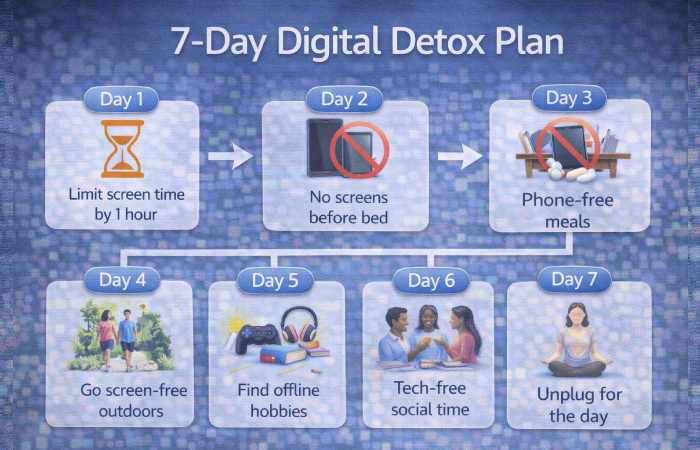
Day 0 — prep (30 minutes)
- Install a usage tracker (iOS Screen Time or Android Digital Wellbeing).
- Identify 3 apps you want to limit (social media, video, news).
- Tell close contacts you’ll be less reachable for short periods.
Day 1 — 24-hour reset
- Turn off social apps and avoid aimless browsing.
- Replace phone time with a walk, reading, or a hobby.
Days 2–3 — implement evening curfew
- No screens after 9 PM (adjust for your bedtime).
- Use an alarm clock instead of phone for morning.
Days 4–6 — structured work & breaks
- Work in 50/10 or 25/5 cycles (Pomodoro).
- During breaks, stand, hydrate, and look out a window.
Day 7 — reflect & adapt
- Check screen-time stats. Note mood, sleep, focus changes.
- Choose one lasting rule to keep (e.g., no devices at dinner).
Clinical and consumer reports suggest two weeks of consistent change is enough to notice measurable sleep and mood benefits, while 30 days helps form long-term habits.
Tools & tactics that make a detox stick
- Use app limits: Built-in Screen Time / Digital Wellbeing to block social apps after a set time.
- Do Not Disturb + Focus modes: Allow only essential calls.
- Physical distance: Charge phone outside the bedroom.
- Notification triage: Turn off nonessential notifications (email, social apps).
- Replace, don’t remove: Have easy substitutes (walks, podcasts, calls with friends).
- Accountability buddy: Partner with a friend or family member.
- Mindful check-ins: Keep a simple mood log (1–10) each evening.
For parents: guiding kids and teens through a detox
- Model the behavior. Kids mirror adults; device rules for everyone work best.
- Create tech-free rituals. Dinnertime, homework time, and bedrooms can be device free.
- Screen-time contracts. Agree on limits and rewards together.
- Teach alternatives. Encourage sports, clubs, reading and hobbies.
- Monitor sleep & mood. If poor sleep or mood is present, prioritize evening curfew. National teen data shows those with very high screen time more often report anxiety and depression symptoms — consider limits especially for teens with 4+ hours/day of non-school screen time.
Measuring success: what to track
- Sleep quality: bedtime, sleep latency, nighttime awakenings, morning energy.
- Screen metrics: daily screen time and social-app time from built-in trackers.
- Mood & anxiety: short daily mood scale (1–10) or weekly GAD-2/PHQ-2 screenings.
- Productivity: number of focused work sessions and subjective focus rating.
- Social connection: number of face-to-face interactions or phone calls with friends/family.
Many people notice better sleep and mood within days of limiting evening screens; attention and productivity benefits build over 1–3 weeks.
Common obstacles and how to beat them
- Fear of missing out (FOMO): Schedule a daily 20–30 minute social-app check instead of constant scanning.
- Work demands: Use Focus modes to allow only work notifications.
- Boredom: Plan replacement activities (walk, reading, hobby).
- Relapse on weekends: Treat weekends as maintenance — allow leisure screens deliberately and mindfully.
Is it safe to “go offline” if you have an important job?
Yes — with planning. Keep essential communication channels open (texts from family, work email if needed). Use “whitelist” contacts and auto-reply on messaging apps to explain limited availability.
The science caveat: correlation ≠ simple causation
Large surveys link high screen time with worse sleep and higher rates of anxiety and depression in teens, but the relationship is complex. Screens can both harm (late-night use, social comparison) and help (social support, telehealth). The practical approach is targeted behavior change: reduce harmful patterns (evening heavy use, doom scrolling) while preserving high-value uses (work, learning, supportive contact).
Quick checklist: 10 practical rules to start your detox today
- No screens 60–90 minutes before bed.
- Turn off nonessential notifications.
- Charge your phone outside the bedroom.
- Schedule two 25–50 minute focused work blocks with short breaks.
- Do a 24-hour social media pause this weekend.
- Replace scrolling with a 20-minute walk or a book.
- Use app limits to block addictive apps after a certain time.
- Do device-free dinners at least three times a week.
- Track screen time and mood weekly.
- Celebrate wins — small changes compound.
FAQs
Q: How long should a digital detox be to feel benefits?
A: Many people feel sleep and mood improvements after 1–7 days; attention and productivity gains often appear within 1–3 weeks with consistent habits.
Q: Will a detox fix anxiety or depression?
A: A detox can reduce contributing factors (sleep loss, social comparison), but it is not a substitute for therapy or medication in clinical depression or anxiety. Use it as one part of a broader care plan.
Q: Can a short daily curfew be as effective as a full detox day?
A: For sleep and sustained improvement, nightly curfews (60–90 minutes before bed) are highly effective and more sustainable than infrequent full-day breaks.
Q: What about using screens for work—do I need to quit?
A: No. The goal is to redesign nonwork use and manage boundaries. For work, use focused-work cycles and mindful breaks to preserve attention.
Final takeaway
A digital detox is an evidence-based, practical tool to improve sleep, reduce anxiety, and restore attention. You don’t need to throw away your phone — start small: an evening curfew, a 24-hour reset, and structured focus/break cycles can produce measurable gains in days to weeks. If you or a family member has severe mood or sleep problems, combine detox strategies with professional care for the best results.