
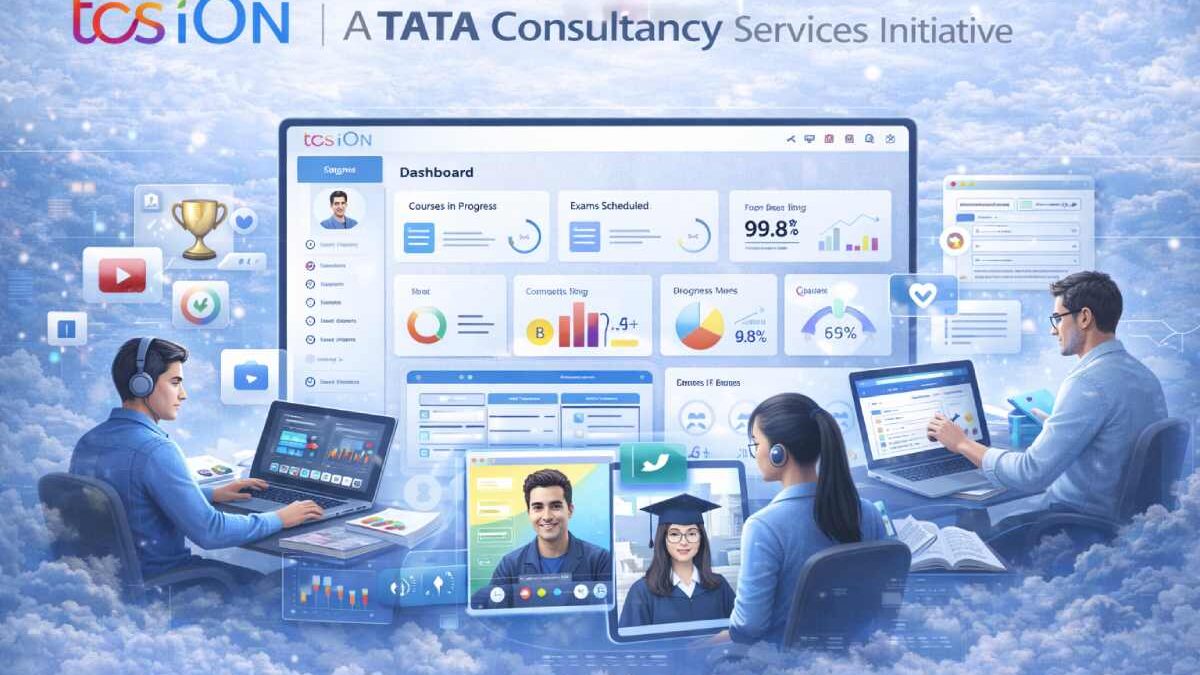
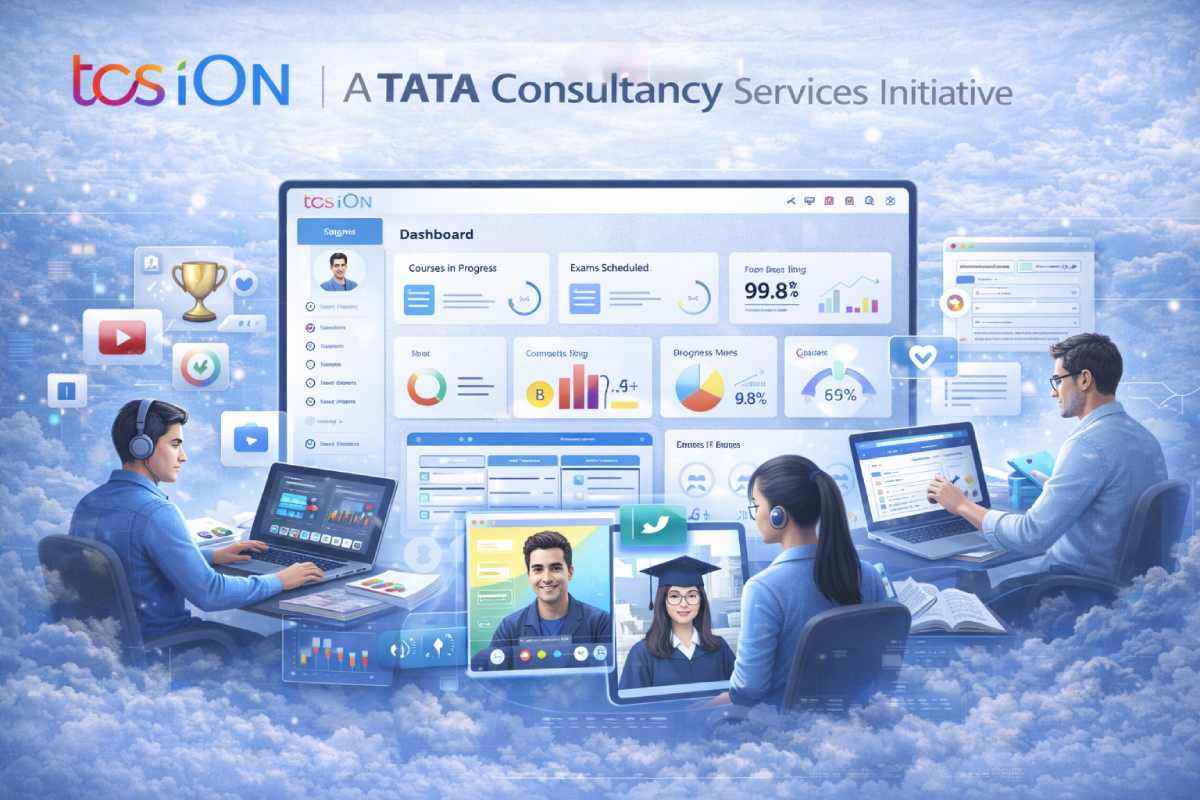
TCS iON is Tata Consultancy Services’ strategic “phygital” platform that combines cloud software, physical exam infrastructure, and AI-driven monitoring to deliver large-scale digital learning, assessments, recruitment, and business services for institutions and enterprises. Below is a practical, in-depth guide to what TCS iON does, how it works, whom it serves, real-world scale and partnerships, implementation tips, and an evaluation checklist for institutions considering the platform.
Table of Contents
Quick snapshot: what TCS iON is and why it matters
TCS iON is an IT-as-a-Service arm of Tata Consultancy Services (TCS) that packages cloud platforms, exam centers (“Digital Zones”), assessment engines, and learning management features into a pay-as-you-use model for schools, colleges, corporations, and government agencies. The platform is built for scale: TCS iON reports having conducted thousands of exams for hundreds of millions of candidates using thousands of exam venues — evidence that this is more than a lab prototype; it’s a national-scale operational platform.
Three features make TCS iON notable:
- Phygital delivery — a combined physical + digital model that can serve remote locations via Digital Zones.
- Assessment & recruitment reach — a standardized testing engine (NQT) and recruitment pipelines for corporates. m
- Command center monitoring — AI and IoT to observe exam venues, candidate behavior, and equipment status in real time for security and continuity.
The core product pillars — what TCS iON actually offers

TCS iON’s portfolio clusters around four product pillars. Each pillar is designed to be usable independently or as an integrated stack.
1) Digital Learning & Skill Platforms
A cloud learning environment with content hosting, course authoring, assessments, certifications, and analytics. Educational institutions and corporates use this to deliver short courses, vocational training, and employability programs. These platforms often integrate with university curricula and corporate learning pathways. (See partnerships below for examples of university collaborations.)
2) Digital Assessments & Exam Management
A secure, proctored exam delivery platform that supports large-scale, computer-based exams with remote and on-site proctoring options. It handles exam creation, question banks, candidate authentication, scheduling, and automated result processing. The solution targets board exams, entrance tests, corporate recruitment tests, and certification programs. TCS iON’s exam infrastructure is supported by Digital Zones and a central command center for monitoring.
3) Recruitment & Talent Services (NQT)
The National Qualifier Test (NQT) is TCS iON’s flagship employability exam that many corporates accept for fresher recruitment. The NQT offers a standardized cognitive and technical evaluation and acts as a one-stop gateway for companies looking to hire at scale. TCS iON opened NQT to many corporates as a common recruitment channel, increasing the test’s market utility.
4) Cloud Business Solutions for SMBs & Institutions
TCS iON offers modular cloud services—ERP, HR, finance, and operations—tailored to smaller institutions and organizations that need enterprise-grade tools without heavy CapEx. This “IT-as-a-Service” approach reduces infrastructure barriers for adoption.
Real scale: the numbers that show it’s production-grade
TCS iON’s public statements highlight scale and operational reach. For example, the platform’s command center was built to monitor more than 6,000 unique exam venues and — according to TCS — the unit had conducted 3,180 exams for more than 200 million candidates across 6,444 exam venues in 643 cities (figures cited in public press releases). Those headline numbers illustrate why the platform is counted as a major nationwide exam and skills infrastructure.
Scale matters because it signals operational maturity: the software must handle concurrency, identity validation, proctoring anomalies, power or network issues at remote centers, and produce auditable results at high volumes. The command center (AI and IoT) directly addresses many of these operational risks.
How the command center and “phygital” model work
TCS iON’s “phygital” model blends cloud platforms with local infrastructural touchpoints:
- Digital Zones: physical exam centers that provide an internet-connected space, hardware, and proctoring resources for candidates who can’t test at home.
- Remote proctoring & AI: webcams, log data, and image/video analytics feed the command center, which flags suspicious behavior or technical failures. Notifications trigger human review and local interventions.
- IoT & Energy Monitoring: sensors monitor UPS, server temperatures, and power events at exam venues to prevent mid-test outages and enable preventive action.
The result is a managed end-to-end exam lifecycle: registration → identity verification → exam delivery → AI monitoring → secure result generation.
Use cases & customer types.
TCS iON targets diverse client categories:
- Education boards and universities: board exams, admissions tests, skill development modules, and online coursework. (Example: MoUs with technical institutes to deliver certificate courses.)
- Corporates: recruitment, employee reskilling, and large-scale assessments (NQT and customized tests).
- Government & public sector: secure citizen exams and qualification programs for large populations.
- SMBs: modular cloud ERP and HR systems to digitize operations without heavy upfront investment.
Partnerships & government/academic collaborations — recent examples
TCS iON actively partners with academic institutions and state bodies to expand digital skilling. Recent partnerships include the TCS iON Placement Success Programme (PSP) pilot with Jawaharlal Nehru Technological University (JNTU) in Telangana, a program aimed at rural youth employability via an immersive 20-week training and placement process. That collaboration demonstrates how TCS iON is being used for regional skill initiatives and job linkage.
Other academic collaborations include certificate programs with technical institutes (IIT partner programs), which point to a strategy of co-creating curriculum and building industry-aligned credentials for students.
The National Qualifier Test (NQT): what it is and why corporates use it
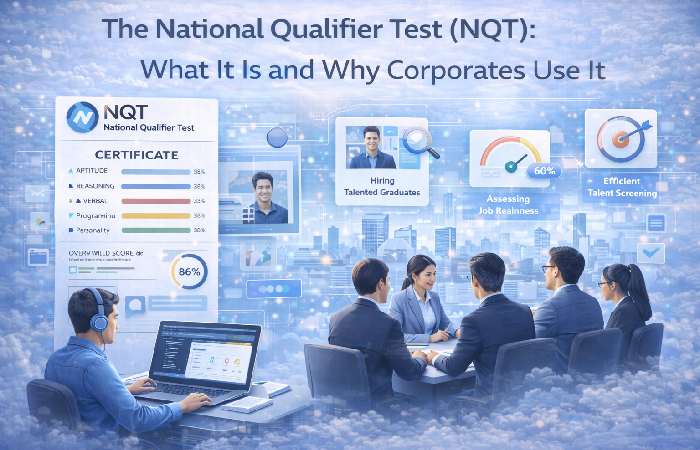
The NQT is a standardized cognitive and skill test intended to screen freshers and early-career candidates across domains. TCS expanded the NQT to be a gateway test for multiple corporates — the idea is to create a common score profile that recruiters can use to hire at scale, reducing individual company screening costs and broadening candidate access. The NQT is delivered via the same TCS iON exam infrastructure and is designed to be taken remotely, with options for candidates who lack home infrastructure to use Digital Zones.
Key benefits of NQT:
- Standardization across organizations (same scoring model).
- Efficiency: a single test can introduce a candidate to multiple potential employers.
- Accessibility: remote delivery and physical hub alternatives increase inclusion.
Security, integrity, and proctoring—how robust are they?
Security and integrity are central to high-stakes exams. Here’s how TCS iON addresses core risks:
- Candidate authentication: multi-factor identity checks, biometrics in some workflows, and on-site verification for Digital Zones.
- AI monitoring: computer vision models check for unauthorized objects, head movement, and other anomalous behavior; AI also monitors system logs, process anomalies, and network behavior. Alerts go to human reviewers in the command center for triage.
- Incident handling: real-time alerts trigger preemptive action (e.g., restarting a device, switching to a backup UPS) to reduce exam disruptions. Including energy and server temperature monitoring reduces the risk of outages during tests.
While no system is foolproof, combining AI monitoring with physical Digital Zones and human oversight reduces single-point failures in remote exam scenarios.
Benefits for institutions — why colleges and boards adopt TCS iON
- Scalability: the cloud model scales for mass testing and large user bases without the heavy upfront capital costs. TCS’s scale cases suggest the model works for millions of candidates.
- Operational simplicity: pay-as-you-use removes the need to maintain complex IT stacks.
- Assured integrity: AI surveillance plus Digital Zones provide a higher integrity posture than basic online testing.
- Analytics & insights: built-in reporting for candidate performance, item analysis, and trends helps educators make data-driven decisions.
Benefits for learners & candidates
- Access: remote delivery, supported by Digital Zones for homes with limited home infrastructure.
- Portability: NQT score validity and the ability to present one standardized credential to multiple employers.
- Upskilling: courses and certifications aligned with industry requirements and placement pathways.
Limitations and common challenges
No platform is perfectly suited to every scenario. Institutions should weigh:
- Internet dependency: although Digital Zones mitigate it, remote candidates still need reliable connectivity for home tests.
- Digital literacy: Some candidates and exam administrators need training to operate the platforms efficiently.
- Privacy & data governance: biometric and video data collection require careful policy, consent, and secure storage to comply with national laws (where applicable).
- One-size limitations: heavily customized pedagogy or assessment formats may require additional integration work.
These are solvable issues, but they require policy, bandwidth, and training investments.
Implementation roadmap — how an institution should pilot TCS iON
If your school, college, or training body is evaluating TCS iON, consider this phased approach:
Phase 0 — Strategic planning
- Define objectives (assessment integrity, reach, cost savings).
- Identify stakeholder sponsors (registrar, IT head, exams office).
1 Phase — Pilot
- Start with a low-stakes exam or a certification program (200–500 candidates).
- Run parallel delivery (on-site & on TCS iON) to validate results and process.
2 Phase — Scale
- Ramp to larger cohorts after fixing process gaps (identity flow, ticketing, incident playbooks).
- Activate Digital Zones in underserved districts where needed.
3 Phase — Optimization
- Integrate analytics into teaching; establish feedback loops to assess test item quality and identify curriculum gaps.
- Evaluate cost per candidate and redefine the service model (pay-as-you-use settings).
Cost & procurement considerations
TCS iON sells modular services; pricing varies by scope (number of candidates, test complexity, proctoring type, and Digital Zone needs). Procurement teams should:
- Negotiate pilot terms, SLAs (uptime, incident response), and data governance terms.
- Include performance KPIs and penalty clauses for service failures.
- Clarify liability for incidents, especially for high-stakes public exams.
Case study snapshots
Skill training & rural youth: TCS iON’s Placement Success Programme (PSP) pilot with JNTU Manthani targets rural youth with a 20-week program that includes placement support through the iON recruitment platform. The project illustrates how iON can be the operational backbone for regional skilling drives.
Academic collaboration: Certificate offerings co-designed with IIT partners deliver workforce-ready certification in cloud systems and infrastructure—showing how iON can host advanced technical curriculum at scale.
Governance, privacy & policy checklist
- Data minimization & retention policy for exam video and logs.
- Candidate consent forms and GDPR/PDPA/India-equivalent compliance review.
- Local backup and disaster recovery plans (power + network contingencies).
- Transparent incident reporting to candidates and stakeholders.
- Periodic third-party security audits and penetration testing.
Decision checklist for institutions
- Do you need mass testing or specialized small cohorts?
- Can you provide basic candidate support and training for digital exams?
- Are your legal and privacy teams clear on video/biometric retention?
- Do you havea budget for Digital Zone activations in remote locations?
- Will NQT or other iON credentials improve your students’ placements? If yes, pilot.
FAQs
Q: Is TCS iON a separate company?
A: TCS iON is a strategic business unit of Tata Consultancy Services, run as a focused product and service line rather than a separate legal entity in most public descriptions.
Q: Can candidates take NQT from home?
A: Yes — the NQT supports remote delivery; Digital Zones are available where home infrastructure is insufficient.
Q: How secure is the exam monitoring?
A: Security uses a mix of AI-enabled monitoring, human review, and Digital Zone oversight. This layered approach enhances integrity but does not eliminate the need for robust local processes and contingency plans.
Q: How do small institutions get started?
A: Start with a pilot (low stakes), focus on process and candidate training, and scale once incident KPIs are met. Procurement should negotiate SLAs and data protection terms.
Final thoughts
TCS iON is a mature, production-scale platform that bridges cloud platforms and physical infrastructure to enable large-scale learning, assessment, and recruitment. Its phygital model, national footprint, and AI-driven command center make it a compelling option for governments, universities, and corporates that need secure, scalable assessment and skilling infrastructure. Institutions should, however, approach implementation methodically — pilot, measure, and scale — while ensuring privacy, consent, and governance are addressed up front.