
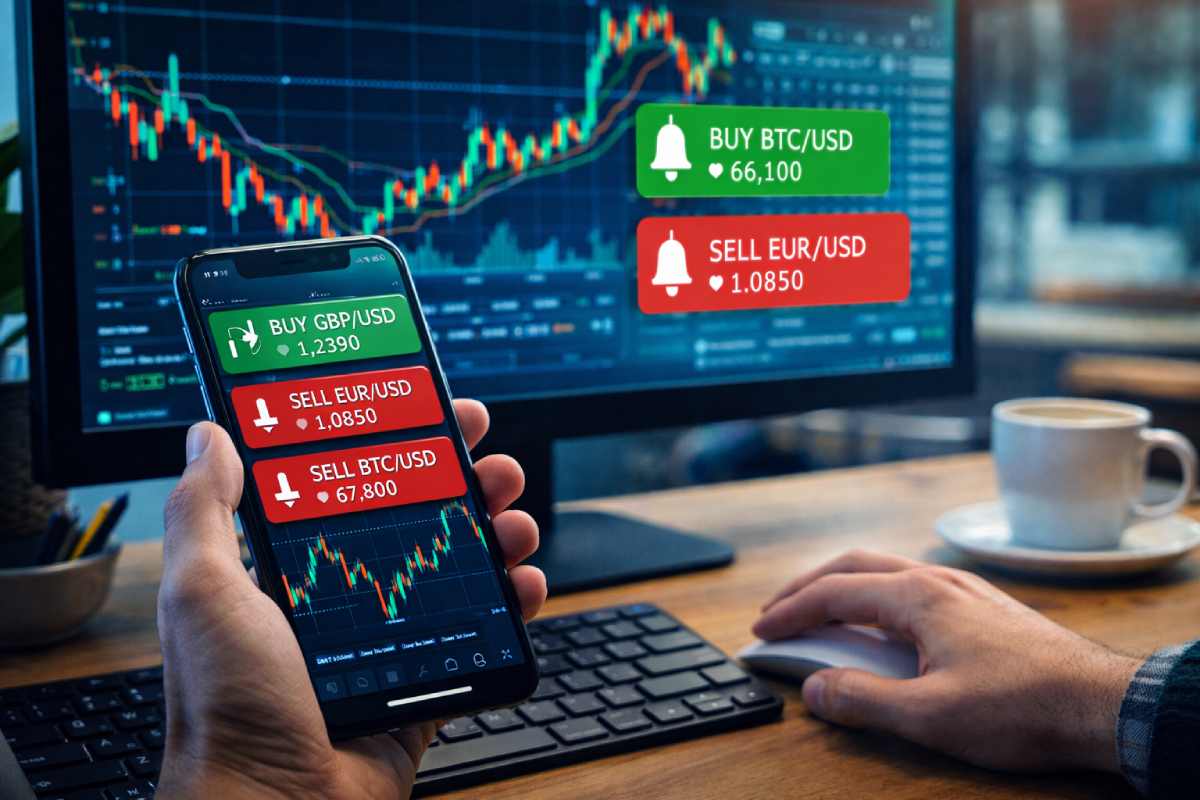
A trading signals provider delivers alerts or recommendations about potential trades — for example, “buy EUR/USD at 1.0850, SL 1.0820, TP 1.0900.” For many traders, these signals are a way to tap outside expertise, save time, or onboard advanced indicators without building them yourself. But not all providers are equal: delivery method, strategy logic, evidence, and verification vary widely. This guide explains how signals work, how to compare providers, and how to protect your capital when using signals.
Table of Contents
What is a trading signals provider?
At its core, a trading signals provider analyzes markets and publishes buy/sell recommendations. Providers fall into three broad categories:
- Human analyst services — experienced traders or advisory desks share setups, often with written reasoning.
- Algorithmic/quant systems — automated models generate signals using technical indicators, statistical models, or machine learning.
- Marketplace aggregators — platforms (marketplaces) where multiple independent providers publish their signals (e.g., MQL5 marketplaces).
Providers may focus on Forex, crypto, stocks, options, or multi-asset portfolios. How a provider generates signals — and how it proves performance — is the most important thing to check before subscribing.
How trading signals are generated: indicators, models, and human judgment
Signals often rely on technical indicators (MACD, RSI, moving averages), pattern recognition, or macro/event analysis. For example, a MACD crossover can be encoded as a buy/sell trigger; more advanced systems combine multiple indicators with position-sizing rules and risk management. But algorithmic models also use price action, volume, liquidity metrics, or even alternative data.
Human providers add context: news interpretation, correlation checks, and discretionary judgment around events (earnings, central bank statements). Hybrid approaches — automated screens with human oversight — are common for professional providers.
Key point: a signal is only the opening idea; the full trade plan (position size, stop, take profit, and risk management) determines whether the signal fits your account.
Delivery methods & execution issues
Trading signals are delivered in many ways:
- Messaging apps (Telegram, WhatsApp) — popular for speed and community features.
- Platform dashboards/web UIs — often with historical logs.
- Broker integrations/APIs — can pre-fill orders or execute automatically (bridging to copy trading).
- MetaTrader/MQL5 signals — use platform-native signal copy features.
Execution risk: manual signals require you to place the trade — delays can cause missed entries or different fills, especially on volatile instruments. Copy trading or broker integrations can eliminate manual execution delays but transfer execution risk to the platform. Research shows manual execution delays are a major reason signal performance in marketing materials does not match follower results.
Signals vs copy trading vs automated strategies — pros and cons
Many traders confuse these approaches. Here’s a clear comparison:
Trading signals
- Pros: Retain decision control; learn from the provider’s reasoning; flexible.
- Cons: Manual execution friction; potential for poor trade timing.
Copy trading - Pros: Automatic replication of provider trades; minimal time required.
- Cons: Less control over position sizing and risk; dependent on the leader’s behavior.
Automated strategies/EAs - Pros: Fast execution, backtestable, consistent rule application.
- Cons: Can be over-fitted in backtests, requires robust hosting and monitoring.
Which is “better”? It depends on your priorities: control and learning (signals), hands-off convenience (copy), or strict execution discipline (automated).
How to evaluate a signals provider – the practical checklist
When evaluating providers, focus on performance transparency, risk metrics, and independent verification. Don’t be seduced by headlines like “85% accuracy” without context. Here’s what matters.
1) Verified performance records
Look for provider performance that is independently verifiable (e.g., Myfxbook, FXBlue, audited statements). Marketplace platforms (like MQL5) show histories but check for cherry-picking. Marketing pages often show best months, not average outcomes.
2) Key metrics to analyze
- Win rate (percent winning trades) — useful but incomplete.
- Average risk-reward ratio — shows payoff per win/loss.
- Expectancy = (Win rate × Avg win) − (Loss rate × Avg loss). This tells you the per-trade edge.
- Max drawdown — how much capital historically fell during losing stretches.
- Sharpe / Sortino ratios — return relative to volatility/downside risk.
A provider with 60% win rate but tiny average wins and large occasional losses can still lose money. Focus on expectancy and drawdown.
3) Sample size & market regimes
Small sample sizes (e.g., <200 trades) are unreliable. Also, check performance across different market regimes (trending vs. ranging), since many signal strategies are regime-dependent.
4) Delivery latency & slippage expectations
Check how signals are delivered and whether the provider or platform supplies pre-filled tickets. Ask the provider for expected slippage and how they handle news events (many signals avoid major events).
5) Transparency about strategy
Providers that explain their logic and risk rules (position size formula, stop rules) are preferable to “black box” promises.
6) Customer support & community
Active support, an honest community, and clear terms (refund policies, trial periods) are essential.
Regulatory & consumer protection considerations
Regulators have grown wary of aggressive marketing in leveraged and crypto markets. The European Securities and Markets Authority (ESMA) and other bodies have issued warnings about misleading claims and confusing regulatory status. Always verify whether a provider or associated broker is regulated in your jurisdiction, and beware of claims that imply guaranteed profits.
Some practical rules:
- Never give a provider direct control of funds unless they are regulated for discretionary management in your jurisdiction.
- Understand the difference between “signals” (non-discretionary tips) and “portfolio management” (discretionary trading with legal obligations).
- Watch for red flags: unverifiable track records, pressure to deposit large funds, or claims of extremely high returns with no risk.
Provider types and examples
Providers specialize by market and delivery style: Forex, crypto, equities, options, or multi-asset. Popular categories include:
- Forex signal services (Telegram/email): many established providers advertise daily signals and educational material. Examples discussed in market reviews include long-running niche leaders.
- Crypto signal groups: often Telegram-based; higher volatility means higher potential returns and higher risk. Regulatory scrutiny of crypto marketing is rising.
- MQL5 Marketplace providers: share signals that can be copied in MetaTrader platforms, enabling automatic copying.
Entity note (examples mentioned in market reviews): ForexSignals.com, 1000pip Builder, and MQL5 are commonly cited in review roundups — but these are examples, not endorsements. Use the evaluation checklist above when assessing them.
Pricing models & subscription economics
Common pricing models:
- Monthly subscriptions (range: $20–$200+, depending on niche and claimed performance).
- Signal bundles / tiered pricing (basic vs premium with more signals and support).
- One-time purchase for EA or course + signals.
Economics matter: if a provider costs $150/month and requires tight risk control that consumes a large portion of capital, your net return after fees may be low. Run the numbers: expected monthly expectancy × capital risked — fees = net return.
How to perform a small-scale live test
Before committing significant funds:
- Paper-trade 30–90 days with the provider signals to confirm practical entry/exit timing.
- Start small (1–2% of capital per trade) on a live account to measure slippage and emotional execution.
- Track metrics: trades, P/L, drawdown, average win/loss, and nightly portfolio review.
- Compare to marketing claims — if results diverge sharply, ask for clarification or request a refund if a trial exists.
FAQs
Q: Are trading signals legal?
Yes, but legality hinges on the business model. Selling signals is usually legal, but managing client funds requires regulatory permissions in many jurisdictions. Always check local law.
Q: Do signal services actually make money?
Some providers have historically delivered positive results, but past performance is not a guarantee, and many services are unverified or cherry-pick results. Focus on verified metrics and independent audits.
Q: Which is safer — signals or copy trading?
Copy trading automates execution (reducing manual delay), but it reduces your control. Signals give flexibility but require discipline and timely action. The “safer” choice depends on your risk tolerance and ability to monitor trades.
Final thoughts & recommended next steps
Trading signals providers can be a valuable tool — for education, idea generation, or trade flow — but use them with skepticism and a robust evaluation process. Always verify claims, test small, and prioritize providers that publish independent, auditable performance metrics. If you want, I can:
- Generate a provider comparison table (top 8 providers by verified metrics) that pulls live data.
- Create a downloadable signal-evaluation spreadsheet (metrics, formulas for expectancy, drawdown).
- Produce infographics: “Signals vs Copy Trading” and “How to Read Signal Performance.”
Please tell me which of those you want me to build next, and I’ll do it now.