
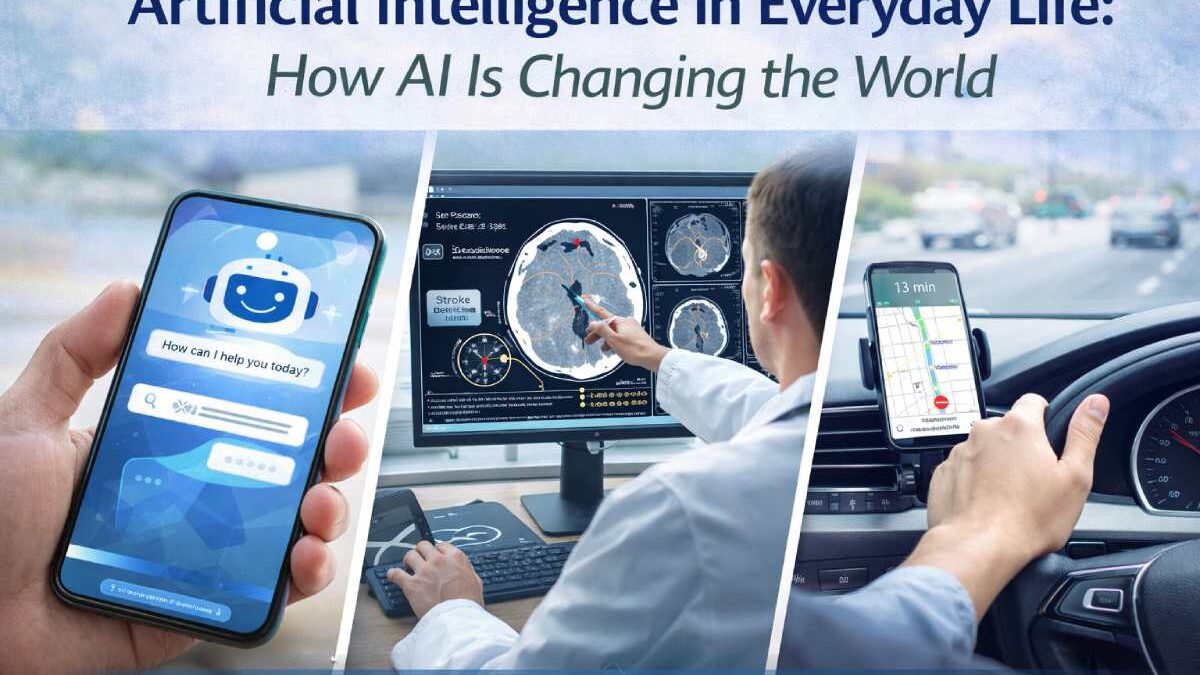
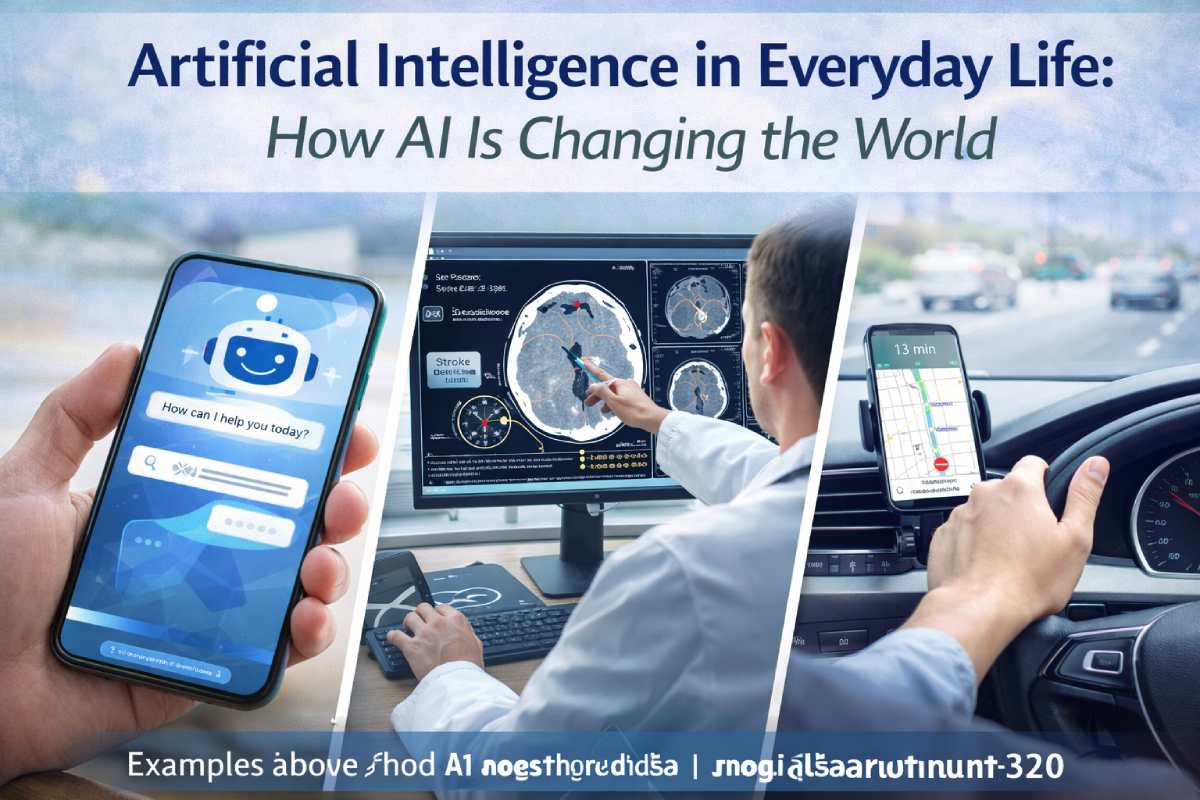
Artificial Intelligence in Everyday Life – Artificial intelligence (AI) is no longer only a subject for computer scientists — it’s becoming part of how most of us live and work. From the smartphone assistant that filters spam in your inbox to the diagnostic tool a radiologist uses, AI systems influence decisions, speed up tasks, and create new services. This article explains what AI really is, gives clear real-world examples across healthcare, transport, and business, and walks through the measurable benefits and the serious risks we must manage.
Note: This piece draws on recent adoption and regulatory data to show how fast AI moved from labs into daily life.
Table of Contents
What AI actually means
At its core, artificial intelligence refers to computer systems that perform tasks that normally require human intelligence — for example, recognizing speech, translating languages, classifying images, or making predictions from data. Today’s most visible AI systems are often machine learning models trained on large datasets to make decisions or generate content (text, images, audio). A special subset called generative AI creates new content (for example, written drafts, images, or code) rather than only labeling input.
How people encounter AI in daily life — quick list
- Search engines and auto-suggest (personalized web results)
- Email filters, spam detection, and smart replies
- Chatbots and virtual assistants (customer service, scheduling)
- Writing and coding assistants (drafting emails, generating code snippets)
- Recommendation engines (shopping, streaming services)
- Navigation and traffic prediction (maps, ETA estimations)
- Fraud detection in banking and personalized finance tools
- Medical image analysis and clinical decision support in healthcare.
Real examples
Everyday / Consumer tools
- Search & personalization: Search engines and content platforms use models to rank results and recommend content based on behavior and context.
- Writing assistants: Tools that suggest phrasing, summarize documents, or draft email replies are now used daily by many office workers. Recent workplace surveys report increasing use of chatbots and writing tools for idea generation and document drafting.
Healthcare
AI helps clinicians by processing medical images, flagging abnormalities, and prioritizing urgent cases. Regulatory pathways have accelerated: the U.S. Food and Drug Administration tracks hundreds of AI-enabled medical devices cleared for clinical use, reflecting rapid uptake in areas like radiology and cardiology. AI systems are used for automated screening (for example, diabetic retinopathy detection) and to assist clinicians in interpreting imaging faster.
The U.S. Food and Drug Administration maintains a public database of AI-enabled medical devices cleared for clinical use, illustrating how rapidly AI tools have been integrated into areas such as radiology, cardiology, and clinical imaging.
Transportation
Autonomous-driving software and traffic optimization rely on perception models, sensor fusion, and predictive algorithms. Major operators now run large fleets of autonomous rides in specific urban areas, and routing/ETA features in everyday navigation apps use AI-powered traffic prediction to save time. Companies at the intersection of AI and vehicles are pushing both convenience and regulatory debates.
Business & Work
Organizations embed AI across functions — marketing personalization, automated customer service, fraud detection, supply-chain forecasting, and code generation for developers. Surveys show many companies report concrete productivity gains after adopting AI tools, though adoption varies by company size and sector.
A short table: AI examples, what they do, and who benefits
| Everyday example | What AI does | Primary benefit |
| Email smart reply | Predicts short responses | Saves time for professionals |
| Streaming recommendations | Ranks content by preference | Better discovery / engagement |
| Radiology CAD tool | Flags suspicious lesions on scans | Faster triage; fewer missed cases |
| Chatbots for support | Answers common queries 24/7 | Reduced wait times; cost savings |
| Dynamic pricing | Recommends prices in real time | Increased revenue for retailers |
| Navigation ETA | Predicts fastest route using live traffic | Shorter commutes for drivers |
How fast is adoption?
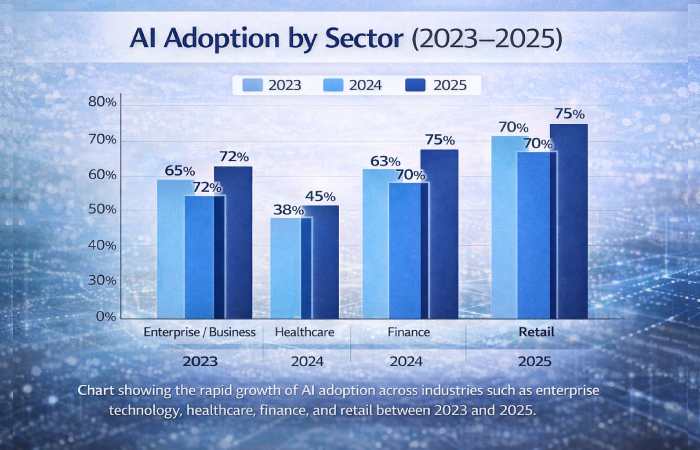
AI adoption exploded in the mid-2020s. Several major reports agree on this pattern:
- Large surveys and indexes show enterprise AI adoption grew from roughly 55% in 2023 to around 78% in 2024 for organizations using AI in at least one function.
- Generative AI user share reached meaningful fractions of populations in 2024–2025; one industry study estimated ~16% of the world’s population used generative AI tools by late 2025.
- Workplace surveys show increasing weekly use of AI — chatbots and writing tools are among the top categories used by employees for consolidation of information and drafting.
These numbers show AI moved rapidly from niche to mainstream in only a few years — mostly driven by easier access, cloud services, and cheaper compute. According to the Stanford AI Index Report, the share of organizations reporting AI use jumped from about 55% in 2023 to roughly 78% in 2024, reflecting how quickly businesses integrated AI into everyday operations.
Benefits — how AI improves everyday life
- Productivity gains — AI reduces time spent on repetitive tasks (summarizing, drafting, basic code), letting humans focus on higher-value work. Many companies report measurable productivity increases after AI adoption.
- Personalization and convenience — From playlists to shopping suggestions, AI tailors experiences to preferences, saving users time and introducing relevant content.
- Better decision support — In healthcare and finance, AI systems can surface patterns humans might miss, improving diagnostics and fraud detection when used responsibly.
- 24/7 automation — Customer service chatbots and monitoring systems operate continuously, improving access and response times.
- Scale — AI lets smaller teams do complex analysis (e.g., small clinics using image-analysis tools) that would previously require specialized staff.
Risks and real harms — what to watch for
While AI brings benefits, it also creates real challenges:
- Bias and fairness: If training data reflect historical biases, AI systems can reproduce or amplify inequality (for instance in hiring tools or criminal-justice scores).
- Misinformation and deepfakes: Generative models can produce convincing but false audio, images, and text, complicating trust online.
- Privacy erosion: Many AI services rely on large datasets containing personal information — if mishandled, this can violate privacy or enable surveillance.
- Job disruption & skill gaps: Some roles may be automated or redefined; surveys find uneven readiness across demographic groups and occupations. Policy makers and companies must plan reskilling.
- Security threats: AI tools can be used to craft more convincing phishing, automate vulnerability discovery, or scale social-engineering attacks; incident counts tied to AI use rose in recent years.
Practical examples that show both sides
Healthcare: better screening — but oversight needed
AI has powered rapid screening tools (for example, diabetic retinopathy screening or CT triage) that expand reach and speed up diagnosis. However, these systems must be validated on diverse populations and integrated into clinical workflows — otherwise they risk false positives/negatives or unequal performance across groups. The FDA maintains a public list of cleared AI-enabled devices to track real-world use.
Workplace assistants: faster writing, but editorial risk
Writers and analysts use AI to draft text or generate code. This saves hours each week, but outputs may include subtle errors, hallucinations, or IP issues. Human review remains essential — AI as co-pilot works best when the user verifies outputs. Recent developer surveys highlight rising use but also growing caution about trusting AI results blindly.
Who builds today’s AI?
Research labs, cloud providers, startups, and academic centers collaborate and compete to build the models and tools used widely. Notable organizations include research labs like OpenAI and Google DeepMind, plus university initiatives such as Stanford HAI that publish indexes and policy research. Automotive and mobility firms such as Tesla also push AI into roads and vehicles. These public and private actors shape capabilities, safety standards, and regulations.
Governance, regulation and trust
Because AI affects public goods (health, safety, elections), governments are increasingly regulating it. Regulatory activity and guidelines rose markedly in 2023–2025 — countries and international bodies publish frameworks for transparency, safety testing, and accountability. Businesses must plan compliance and invest in governance (model risk management, auditing, and red-team testing).
Future trends to watch
- Widespread agentic assistants: AI agents that perform multi-step tasks (book travel, negotiate) will become more capable, raising both convenience and safety questions.
- Specialized domain models: Expect clinical, legal, and scientific models tuned for professional use, rather than general chatbots, enabling higher-quality decision support in regulated settings.
- Lower cost & broader access: As inference costs fall, more organizations and individuals will use advanced AI — widening adoption but also increasing the need for risk controls.
- Policy & standards maturation: International coordination on AI safety, transparency, and rights will shape which uses scale quickly and which require stronger safeguards.
How individuals and organizations should approach AI
For individuals
- Use AI tools as time-savers, not unquestioned authorities — always verify important outputs.
- Protect privacy: check app data policies before uploading sensitive documents or images.
- Learn AI literacy basics: know common failure modes (hallucinations, bias).
- Upskill in complementary areas: critical thinking, evaluation, domain knowledge.
For organizations
- Start with pilot projects that measure concrete KPIs (time saved, error reduction).
- Build governance: model inventories, testing on representative data, human-in-the-loop review.
- Invest in employee reskilling and clear role definitions.
- Monitor regulatory requirements in your industry and region.
FAQ
Q — Is AI already replacing jobs?
A — AI automates tasks, not jobs in most cases; it changes job content. Some roles face disruption, but many organizations report using AI to boost productivity and allow workers to focus on higher-value tasks. Reskilling matters.
Q — Can AI be trusted for healthcare decisions?
A — AI can assist clinicians and improve screening, but it should augment, not replace, clinician judgment until validated and regulated for specific uses. FDA-cleared tools are one sign of clinical validation.
Q — How do I know an AI app is safe to use?
A — Look for transparency about data usage, third-party audits, industry certifications (where available), and clear human oversight policies. Organizations should require model testing and explainability for high-risk use cases.
Q — Will AI make society more unequal?
A — Without deliberate policy and access investments, AI could widen gaps (between firms and countries, skilled vs less-skilled workers). Public policy, education, and inclusive deployment can mitigate this.
Final takeaway
AI already shapes everyday experiences — search, work, healthcare, transport, and commerce. Its rapid adoption brings real productivity and accessibility benefits, but it also demands robust governance, human oversight, and public-policy solutions to address bias, privacy, and economic disruption. By learning where AI helps and where it can harm, individuals and organizations can harness its advantages while managing risks responsibly.