
Key Takeaways
- Short city trips can become complicated because of traffic, parking, transfers, uneven sidewalks, and uncertain arrival times.
- Digital tools can combine planning, booking, payment, and live service updates in a simpler trip experience.
- On-demand transportation can help connect homes, workplaces, and local destinations with bus and rail stations.
- Convenience should be balanced with safety, affordability, accessibility, privacy, and support for public transportation.
- The most practical urban trips often combine walking, cycling, transit, and on-demand services rather than relying on a single mode.
How Digital Transit Tools Can Make Short City Trips Easier: A short trip across town can require more effort than a longer journey. Getting to a station, finding a safe pickup spot, paying for a ride, checking for delays, and reaching the final destination can create a chain of small decisions. For people in places where the service is available, an app to request robotaxi service is one more option in the changing local travel mix.
Digital transit tools are most useful when they remove friction without making travelers choose between convenience and clarity. A well-designed trip experience helps a rider see realistic travel times, understand the full cost, receive service updates, and make a backup plan before leaving.
Table of Contents
Why Short Trips Can Be Surprisingly Difficult
A two-mile trip may sound simple, but distance is only one part of the experience. A worker may need to walk from a train platform to an office entrance. A parent may need to make a quick stop at the pharmacy while managing groceries or a child. A visitor may be unfamiliar with local streets, fare rules, or pickup zones near a hotel.
Cars can solve some of these problems, but they can add others. Parking availability, congestion, garage fees, and the time spent entering and leaving a parking facility can make a short drive less convenient than it first appears. The best option depends on the entire door-to-door journey, not just time spent inside a vehicle.
What Digital Transit Tools Actually Do
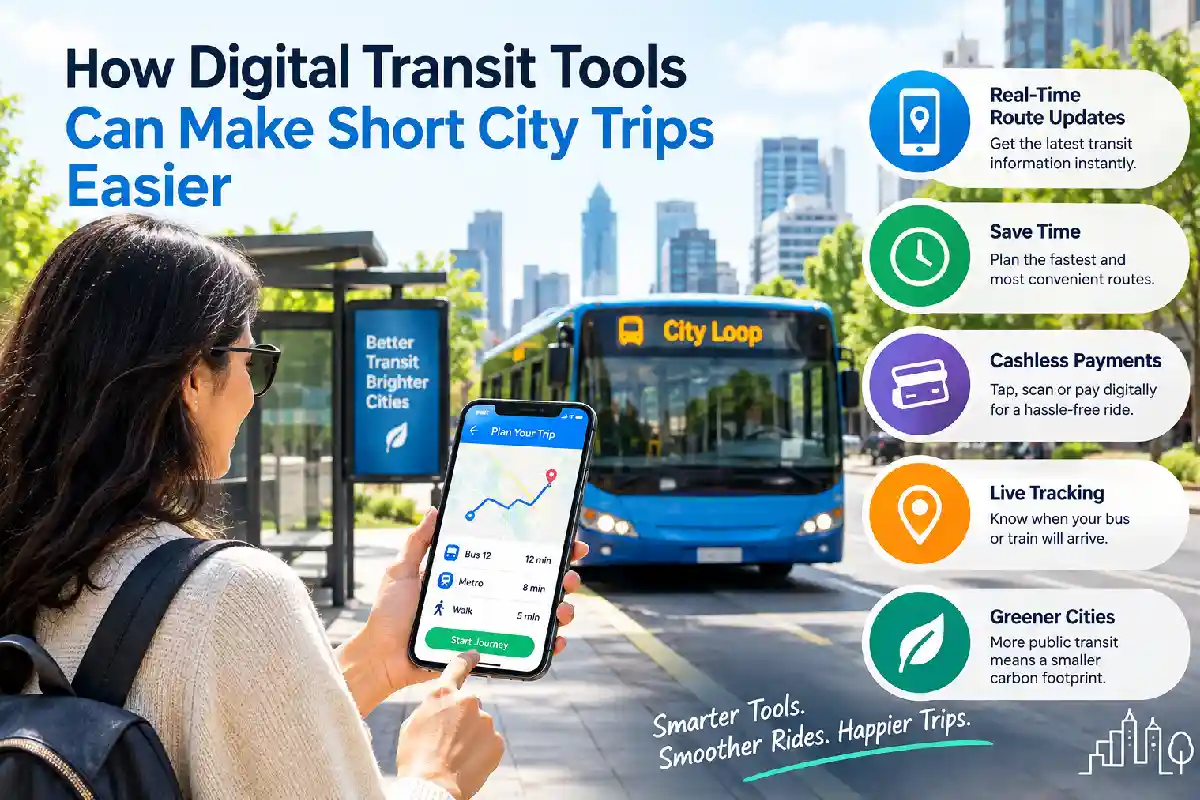
Digital transit tools include mobile trip planners, real-time arrival displays, digital tickets, fare payment systems, ride-request platforms, customer support channels, and disruption alerts. Their value is not simply that they put transportation on a phone. Their real value is reducing the number of separate steps needed to complete a trip.
For example, BART began allowing riders to plan and book certain short Uber trips to and from participating stations through its app in January 2026. This type of first-mile and last-mile connection can show a traveler the local ride, transit segment, and overall journey in one place.
Useful Features to Compare
- Real-time arrival and departure information
- Clear walking, pickup, and drop-off directions
- Upfront fare details before booking
- Step-free or mobility-device-friendly route options
- Simple payment methods and understandable receipts
- Alerts for delays, cancellations, and route changes
- Phone support for riders who cannot use an app
The Role of First-Mile and Last-Mile Travel
First-mile travel is the trip from a person’s starting point to a transit stop. Last-mile travel is the trip from the final stop to the destination. These distances may be short, but they can determine whether public transit feels practical, especially when walking is difficult, buses are infrequent, or trips occur late at night.
Digital tools can make these connections easier to understand. Instead of asking riders to piece together separate schedules, maps, fares, and booking systems, a connected planner can show how walking, biking, a local shuttle, rail, and an on-demand ride may work together. This does not make every option right for every trip, but it gives riders a clearer basis for comparison.
How On-Demand Transportation Fits Into City Travel
On-demand transportation responds to a rider’s request rather than operating on a fixed timetable and route. It can include private point-to-point rides, shared rides, public microtransit, and services designed to link neighborhoods with major transit stations. Each model may differ in price, wait time, operating area, and reservation rules.
Questions Riders Should Ask
- Does the service cover both the pickup point and the destination?
- Is the ride private, shared, or part of a fixed-route system?
- What is the expected pickup window?
- Can the vehicle accommodate a wheelchair, stroller, or other mobility device?
- Can a ride be booked by phone?
- Does the service conveniently connect with bus or rail schedules?
What Automated Travel May Change
Automated transportation introduces another way to think about short city trips. Vehicles using advanced driving systems may offer a more consistent booking experience in approved service areas. However, riders still need clear information about coverage, pickup locations, remote assistance, accessibility, and what happens when a vehicle cannot continue as planned.
Trust matters as much as technology. Riders should know how to contact support, how service changes are communicated, and how the operator handles unusual road conditions or emergencies. Cities and providers also need to consider whether automated services improve connections for people with limited transportation options.
The Tradeoffs Cities and Riders Should Consider
A transportation tool is not automatically beneficial just because it is fast or easy to book. Cities and riders should consider safety, cost, congestion, emissions, privacy, digital access, and the effect on buses and trains. People without smartphones, credit cards, reliable data plans, or comfort with apps should not be excluded from essential mobility.
Transportation choices can also shape development patterns. Research from Northeastern University found that rideshare availability was associated with faster growth at the edges of many U.S. cities studied, particularly where transit service was weaker. That relationship is a reminder that travel technology can influence more than a single trip.
Benefits and Risks to Examine
- Benefits may include better station access, more flexibility, clearer travel information, and additional options for people without cars.
- Risks may include increased vehicle traffic, unclear pricing during peak periods, location data concerns, and reduced attention to reliable fixed-route transit.
A Simple Method for Choosing the Right Travel Option
- Check the full distance. Include walking, transfers, and the final trip from the stop to the door.
- Compare total travel time. Account for waiting, parking, and pickup time, not only vehicle time.
- Review the full price. Consider fares, booking fees, parking, and any variable pricing.
- Confirm access needs. Check for elevators, curb access, room for mobility devices, and assistance options.
- Check reliability. Read service alerts, operating hours, and pickup estimates.
- Keep a backup plan. Save an alternative route for delays, cancellations, or poor weather.
What to Watch Through
For the rest of 2026, city travelers may see more connected trip planners, expanded digital payment choices, closer coordination between transit and on-demand services, and continued automated-vehicle testing in selected locations. The strongest systems will not treat a single mode as the answer for every journey.
Buses, trains, walking, cycling, shared rides, and automated services can each serve different needs. Digital tools deliver the greatest value when they make those choices easier to understand, more accessible to use, and more dependable for the everyday short trips that keep a city moving.